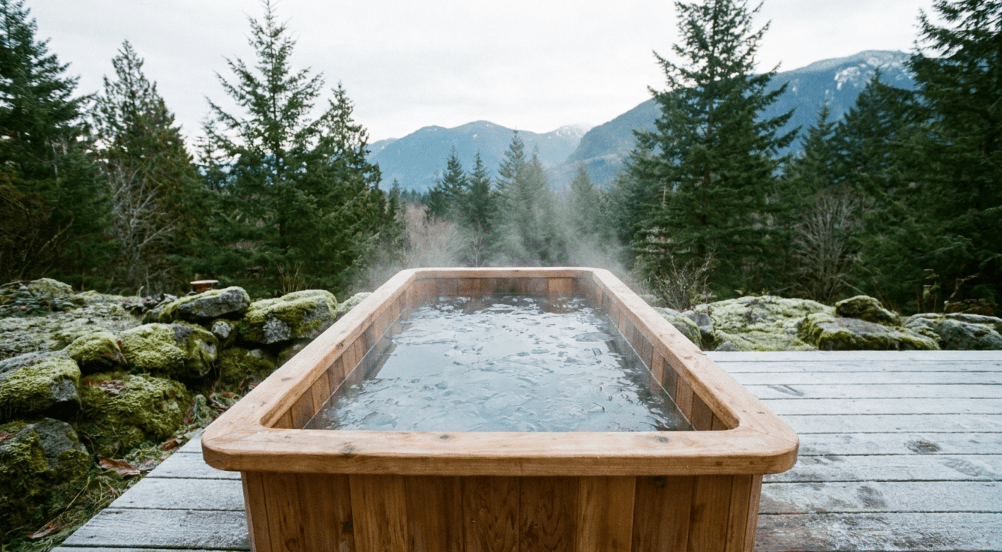
A plug-in cold plunge tub sitting on an existing GFCI-protected outlet, with a garden hose fill and manual drain, is a genuine afternoon DIY project for most owners. Once the install needs a new electrical circuit, a poured concrete pad, or a dedicated drain line, professional help commonly runs $500 to $1,500 on top of the tub itself, and that gap is usually where the real DIY-versus-pro decision actually lives. Here is how the tradeoffs break down piece by piece.
1. What Does a Pure DIY Install Actually Involve?
At the simplest end, a DIY install means placing the tub on level, stable ground, either pavers, a composite pad, or reinforced decking rated for the water weight, plugging the chiller into an existing GFCI outlet within cord reach, filling with a garden hose, and manually draining through a valve or by pump when needed. Most tubs in this category ship with clear setup instructions and no special tools beyond a level and basic hand tools. Total added cost beyond the tub is often under $100, mostly for a hose, a leveling pad, or a extension of GFCI-rated cord if needed.
Budget an afternoon rather than an hour for a first-time install, even a simple one. Unboxing, checking the shell for shipping damage, leveling the base, and running the fill for the first time all take longer than expected the first time through, and rushing the leveling step in particular is a common mistake, since a tub set even slightly off level can stress the shell seams over time as it holds hundreds of pounds of water unevenly.
2. When Does a New Electrical Circuit Become Necessary?
Larger chillers, especially anything drawing enough current to need a dedicated 240V circuit, typically cannot just plug into an existing household outlet. That means running new wire from the panel, which is licensed-electrician territory in most jurisdictions and commonly costs $300 to $800 depending on distance from the panel and whether the wall or slab needs to be opened. This is the single most common reason a “DIY” cold plunge project ends up needing a paid professional for at least one piece of the job.
It is also worth checking local permit requirements before assuming any electrical work can happen off the books. Many jurisdictions require a permit and inspection for a new dedicated circuit, even a small one added to an existing panel in a garage, and skipping that step can create real problems later, whether during a home sale or an insurance claim tied to an electrical fire. A licensed electrician typically handles the permit paperwork as part of the job, which is one more reason bundling the electrical piece into a single professional visit tends to be simpler than trying to manage it separately. The permit fee itself is usually modest, often $50 to $150 depending on the municipality, a small price for documentation that holds up if a future buyer or an inspector ever asks about the work.
3. What About the Pad or Foundation?
A filled cold plunge tub is heavy, often 800 to 1,200 pounds including water depending on size, and needs a level, stable surface rated to carry that weight without shifting or settling unevenly. Existing concrete, a properly rated deck, or paver stones handle this without extra work. Bare dirt, grass, or an unrated wood deck usually do not, and pouring a small concrete pad runs roughly $300 to $700 for a DIY-sized footprint if done professionally, less if you are comfortable forming and pouring it yourself.
4. Does Plumbing Ever Come Into Play?
Most budget setups skip permanent plumbing entirely and rely on hose fill and manual or pump-assisted drain into a yard or floor drain. A dedicated drain line tied into existing plumbing is a nicer, more convenient setup but adds real cost, commonly a few hundred dollars for a straightforward run to an existing drain, more if the distance is longer or a floor needs to be cut. For most budget buyers, skipping permanent plumbing and living with manual drainage is the more sensible tradeoff.
5. So Which Pieces Are Worth Paying a Pro For?
Electrical work involving a new circuit is the clearest case for hiring out, both for safety and because it is usually required by local code for anything beyond a simple existing-outlet plug-in. A poured pad is the next most common professional add, mainly for buyers without DIY concrete experience. Everything else, placement, hose fill, manual drain, basic maintenance, is reasonable for most owners to handle themselves. Buyers deciding how much of the project to take on personally, and wanting to compare which tub sizes ship as simpler plug-in units versus which need a dedicated circuit from the start, can check current listings through SweatDecks.com before ordering.
6. What Does the Research Say About Whether the Install Method Matters?
The install approach has no bearing on the physiological research behind cold water immersion, since none of it distinguishes between a DIY plug-in tub and a professionally installed one, only water temperature and exposure duration. A 2025 systematic review and meta-analysis in PLoS One found a genuinely mixed picture across health and wellbeing outcomes tied to cold water immersion. A Cochrane review on cold-water immersion for muscle soreness after exercise found a modest reduction in soreness with low-certainty evidence behind much of it, and a 2023 meta-analysis in Frontiers in Physiology reported some benefit for fatigue recovery and exercise performance. A well-installed budget DIY tub set to the right temperature should be expected to deliver the same physiological response as a fully professionally installed one at the same temperature and duration.
Frequently Asked Questions
How much does professional cold plunge installation typically cost?
Commonly $500 to $1,500 on top of the tub price, depending on electrical distance and whether drainage work is needed.
Can a beginner install a cold plunge themselves?
For a simple plug-in unit with hose fill and manual drain, yes. Anything needing a new circuit or a poured pad is a bigger project.
What is the single biggest DIY mistake with cold plunge electrical work?
Plugging equipment into a standard outlet instead of a GFCI-protected one, which is both a safety risk and can void a warranty.
Does DIY install actually save money on a budget cold plunge?
Usually, if the site already has a suitable outlet and level ground. Savings shrink once new circuits or a pad become necessary.
Should you hire an electrician even for a mostly DIY install?
Yes, for the electrical portion specifically, given the safety stakes of equipment running near standing water.
References
- “Effects of cold-water immersion on health and wellbeing: A systematic review and meta-analysis.” PLoS One, 2025. https://pubmed.ncbi.nlm.nih.gov/39879231/
- “Cold-water immersion (cryotherapy) for preventing and treating muscle soreness after exercise.” Cochrane Database of Systematic Reviews, 2012. https://pubmed.ncbi.nlm.nih.gov/22336838/
- “Effects of cold water immersion after exercise on fatigue recovery and exercise performance: meta analysis.” Frontiers in Physiology, 2023. https://pubmed.ncbi.nlm.nih.gov/36744038/